EN
Water treatment in ethanol production is often seen as a cost center and a compliance hurdle. But when integrated with biogas recovery and process heat reuse, it becomes a driver of lower operating cost, new energy revenue, and a smaller environmental footprint. In over fifteen years working on integrated grain-to-food-energy projects, I’ve seen that the most profitable corn ethanol plants treat wastewater as a resource, not a waste. This article explains how a closed-loop water system works, from the specific treatment technologies to the economics that make it pay.
Corn ethanol plants are significant water users. A typical dry mill plant using traditional technology consumes roughly 3 to 5 gallons of water per gallon of ethanol produced. Newer, more efficient designs bring that number below 3 gallons, but water intake remains a major operational factor. The water serves multiple points: cooling tower makeup, stillage evaporation, liquefaction, and clean-in-place systems. Each stream picks up different contaminants.
Cooling tower blowdown contains dissolved solids that build up through evaporation. Stillage condensate, the water recovered from thin stillage evaporation, carries volatile organic acids and residual sugars, giving it a high chemical oxygen demand. Clean-in-place rinse water adds caustic and acid cleaning chemicals. Together these streams create a wastewater with variable COD from 5,000 to over 30,000 mg/L, suspended solids, and pH swings between 4 and 11 depending on the cleaning cycle.
The following table outlines typical raw wastewater characteristics from sampling in corn-to-ethanol plants we have studied.
| Wastewater Source | COD (mg/L) | TSS (mg/L) | pH |
|---|---|---|---|
| Stillage condensate | 15,000 – 30,000 | 1,000 – 3,000 | 4 – 6 |
| Cooling tower blowdown | 500 – 2,000 | 200 – 500 | 7 – 9 |
| CIP rinse water | 2,000 – 8,000 | 500 – 1,500 | 2 – 12 |
These figures represent typical ranges; actual values depend on plant configuration and cleaning practices. The high organic load means that discharging this water without treatment is not only environmentally unacceptable but also increasingly penalized by rising effluent surcharge rates.
Regulatory pressure on ethanol plants has tightened in many jurisdictions, pushing operators toward water recycling not just as a sustainability move but as a financial necessity. The wastewater composition also happens to be well suited for anaerobic digestion, which opens the door to biogas generation—a point we will return to.
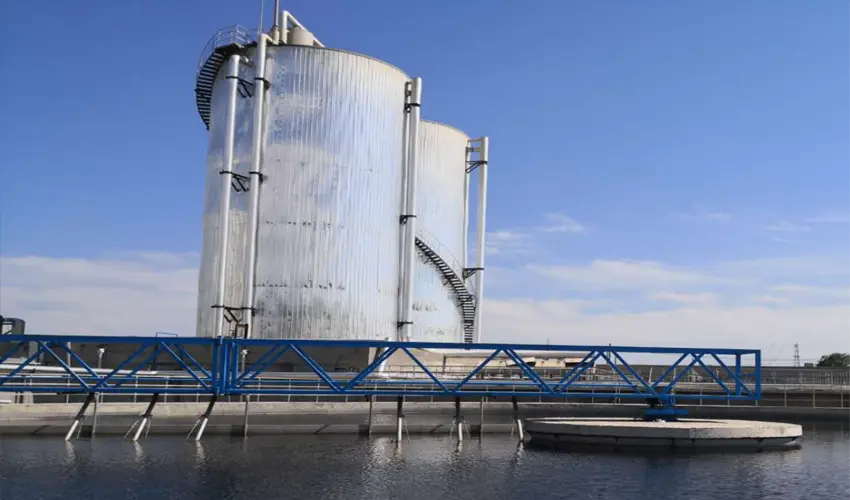
The first stage of treatment for ethanol plant effluent is almost always biological, because the high organic content makes it energetically favorable to recover rather than oxidize. The two main options are anaerobic digestion followed by aerobic polishing, or a combined membrane bioreactor system.
Anaerobic digestion uses microorganisms that break down organic matter in the absence of oxygen, producing methane-rich biogas as a byproduct. A well-designed upflow anaerobic sludge blanket reactor or an expanded granular sludge bed reactor can remove 80 to 90 percent of the incoming COD while generating roughly 0.35 cubic meters of methane per kilogram of COD removed. This methane can be burned in a boiler or fed to a combined heat and power engine, offsetting natural gas consumption elsewhere in the plant.
The anaerobic effluent still contains residual organics, so it passes to an aerobic stage—usually a conventional activated sludge system or a sequencing batch reactor—to bring COD down to levels suitable for discharge or advanced recycling. In newer plants, a membrane bioreactor combines the aerobic biological stage with ultrafiltration membranes, producing a high-clarity effluent that simplifies downstream water reuse.
The table below compares the key process decisions.
| Treatment Stage | Technology Option | COD Removal | Byproduct |
|---|---|---|---|
| Anaerobic | UASB / EGSB | 80–90% | Biogas |
| Aerobic | Activated sludge | 90–95% after anaerobic | Sludge |
| Combined MBR | Membrane bioreactor | 98%+ | Low-turbidity effluent |
The choice between traditional anaerobic-plus-aerobic and MBR depends on space availability, capital budget, and the target water quality for recycling. Many of the plants we have designed for clients start with an anaerobic step because the biogas value typically recovers the capital cost of the digester within three to five years.
Once the bulk of the organics and solids are removed, the biologically treated water moves to advanced separation steps that make reuse possible. The goal is to produce water that can substitute for fresh water in cooling towers, boiler feed, or even process makeup.
Reverse osmosis is the workhorse for dissolved solids removal. The membranes reject almost all remaining salts, organic molecules, and silica, yielding permeate with conductivity below 20 microsiemens per centimeter. For cooling tower makeup, RO permeate is often blended with filtered condensate from the stillage evaporators. For boiler feed, it needs to pass through electrodeionization or mixed-bed polishing to meet the more stringent conductivity requirements.
Condensate recovery from the evaporator system is a major source of recyclable water. The thin stillage evaporation step produces a large volume of condensate that, if properly stripped of volatiles, can go directly back to the front end of the plant for liquefaction. This single stream often recovers 30 to 40 percent of a plant’s total water requirement.
A fully closed-loop plant uses a combination of these recycle streams to approach a near-zero liquid discharge state. In a zero liquid discharge configuration, the reject brine from RO and any remaining blowdown pass through an evaporator-crystallizer that converts dissolved solids into a solid cake for off-site disposal. While the capital cost of a ZLD system is high, it eliminates the need for a discharge permit and can be justified in areas where water costs exceed US$3 to $4 per cubic meter.
If your plant handles variable-strength wastewater and you are considering membrane treatment, confirming the correct MBR sizing early in the design phase avoids expensive retrofits later. Send your water quality data and capacity target to bjhn@agrifamgroup.com, and we can help review the pretreatment requirements.
The anaerobic digester at the heart of the wastewater treatment system does more than just reduce COD. It produces a methane-rich biogas stream that can offset 15 to 25 percent of a plant’s total thermal energy demand, depending on digester efficiency and wastewater load. In a typical 50 million gallon per year ethanol plant, the digester can generate enough biogas to fire a 1 to 2 MW combined heat and power unit, covering a meaningful fraction of the plant’s electricity needs in addition to heat.
Capturing this value means designing the digester to produce a consistent gas flow and integrating gas storage and cleaning equipment. Hydrogen sulfide in the biogas must be removed to prevent corrosion in boilers and engines, which adds a small scrubbing unit but maintains equipment life. The waste heat from the engine or boiler is fed back to the distillation columns, fitting within the plant’s existing heat integration network.
AGRIFAM’s integrated alcohol production solutions incorporate biogas capture and energy cascade utilization as part of the full plant design, not as an afterthought. By designing the water treatment and energy recovery systems together from the start, the plant avoids the duplicated piping and control systems that often emerge when biogas is retrofitted into an existing facility.
The combination of reduced freshwater intake, avoided wastewater surcharges, and biogas energy recovery creates a financial case that usually pays back the treatment infrastructure in under five years. Plants that once paid to dispose of stillage condensate now reuse it, cutting water purchase costs and effluent fees simultaneously. The biogas fuel value alone can amount to hundreds of thousands of dollars per year in avoided natural gas purchases.
From an environmental standpoint, the benefits are equally direct. Water consumption per gallon of ethanol drops by 40 to 60 percent compared to a once-through system. The anaerobic digester captures methane that would otherwise be released if wastewater were treated in open lagoons—methane with a global warming potential 25 times that of carbon dioxide. The circular model turns corn into fuel, feed, and recovered water, aligning with the closed-loop industrial chain principles that modern agricultural processing demands.
Balancing capital expenditure against long-term water and energy costs can be complex, but a properly sized closed-loop system pays for itself through reduced intake charges, biogas revenue, and avoided penalties. For a site-specific water recycling assessment, send your current water balance data and production capacity to bjhn@agrifamgroup.com or call 010-8591 2286.
A well-integrated plant can recycle 60 to 75 percent of its total process water, depending on feedstock and local water quality standards. The largest return streams are stillage evaporator condensate and RO permeate from the advanced treatment system. The limiting factor is usually the salt load in the cooling tower blowdown, which requires a purge unless a zero liquid discharge system is in place. Plants in water-scarce regions that install ZLD can approach 95 percent reuse.
In our project analysis, the payback typically falls between three and five years, driven mainly by biogas energy savings and reduced water purchase costs. A plant paying US$2 per cubic meter for water and US$4 per million BTU for natural gas can see annual savings large enough to recover the incremental capital within that window. The exact number depends on the scale of the digester and local utility rates.
No, properly treated water used for cooling or boiler feed does not contact the ethanol product, so there is no impact on fuel-grade ethanol quality. For process water recycled to liquefaction, the water meets food-grade standards after RO and disinfection. Production rate is unaffected because the recycled water fully meets the water quality demand of each unit operation.
The two biggest hurdles are managing salt accumulation in the cooling loop and handling variable organic loads during start-ups and shut-downs. Both require robust instrumentation and a flexible treatment train capable of handling swings. Early planning of the water balance and segregation of high- and low-conductivity streams make the upgrade far simpler. For any ethanol project, the right water system depends on local water costs, discharge limits, and energy prices. Sharing your project specifics with our team lets us run a water balance and economic model tailored to your site—reach out at bjhn@agrifamgroup.com.
If you’re interested, check out these related articles:
Driving Global Food Conservation Through Technological Innovation







bjhn@agrifamgroup.com