EN
The shift toward modernized poultry industrial parks reflects something deeper than just operational upgrades. These facilities represent a fundamental rethinking of how large-scale poultry production can balance efficiency with genuine sustainability and animal welfare concerns. Having worked through the practical challenges of integrating multiple production stages under unified management, the complexity becomes apparent quickly. Agrifam Co., Ltd. approaches this challenge by providing integrated agricultural solutions that address the full spectrum of sustainable livestock farming requirements.
Designing a high-efficiency poultry industrial park demands more than standard facility planning. The real challenge lies in creating layouts where operational flow and resource utilization reinforce each other rather than compete. Effective poultry industrial park design starts with site selection criteria that account for biosecurity requirements, water access, and transportation logistics simultaneously. Master planning poultry solutions must integrate hatcheries, breeding farms, and processing units into systems that function as unified operations rather than disconnected facilities sharing geography. A modular poultry farm design approach builds in the flexibility that real-world operations require, allowing expansion without disrupting existing production cycles.
Stringent poultry farm biosecurity measures form the foundation of any viable design. Controlled access points and sanitation protocols prevent disease outbreaks that can devastate entire operations within days. Operational workflow efficiency determines whether a facility operates profitably or struggles with hidden costs. Designs that streamline processes from feeding through waste management eliminate the bottlenecks that accumulate expenses over time. Environmental impact assessments identify potential issues before they become regulatory problems or community conflicts. Building future scalability into initial designs costs less than retrofitting later and allows adaptation to market shifts that no one can fully predict.
Advanced engineering transforms theoretical sustainability goals into measurable operational improvements. Energy efficiency poultry facilities combine renewable energy sources with optimized climate control systems to reduce both costs and environmental impact. Automated feeding systems eliminate the inconsistencies that manual operations introduce, while intelligent environmental control poultry houses maintain conditions that directly affect bird health and growth rates. Comprehensive waste management poultry industry solutions convert what would otherwise be disposal costs into revenue streams through manure processing into biogas or organic fertilizer. This circular approach addresses multiple challenges simultaneously.
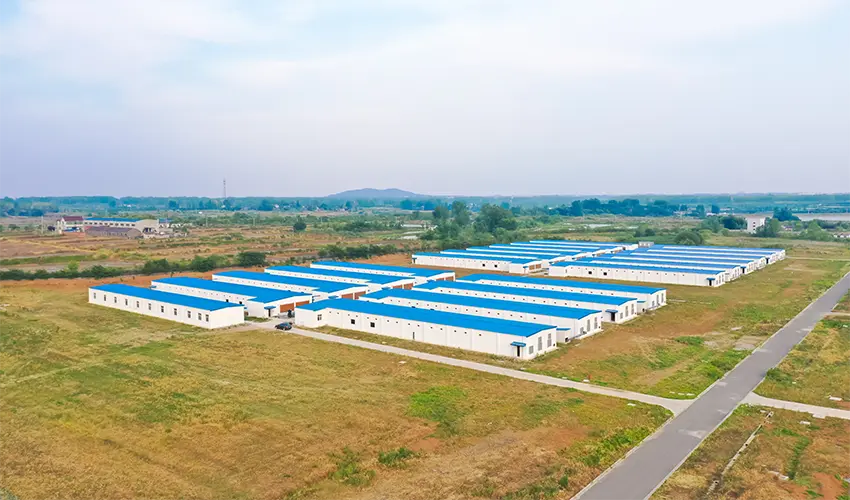
Smart farming solutions livestock introduce precision that manual operations cannot match. Automation reduces labor costs while eliminating human error in feeding schedules and climate management. Advanced climate control systems maintain temperature and humidity within ranges that reduce bird stress and improve feed conversion rates. The difference in feed efficiency alone often justifies equipment investments within two to three production cycles. Waste-to-energy systems transform poultry manure into biogas for facility power or organic fertilizer for sale. This resource optimization poultry approach cuts operational expenses while addressing environmental concerns that increasingly affect market access and regulatory compliance. Renewable energy poultry farms demonstrate that production efficiency and environmental responsibility can align rather than conflict.
The full value of integrated poultry industrial parks emerges when the supply chain operates as a continuous system rather than a series of handoffs between separate businesses. Poultry processing plant design incorporates technologies for slaughter, packaging, and chilling that maintain product quality from production through distribution. This integrated agricultural supply chain approach makes food safety standards poultry verification straightforward because every step occurs under unified management. Logistics and supply chain optimization poultry reduces the time and handling between production and retail, which directly affects product quality and shelf life. Hatchery planning solutions and feed mill engineering ensure that inputs meet the same quality standards as outputs, creating consistency that builds market reputation.
You might be interested in learning more about how we are 《Driving Global Food Conservation Through Technological Innovation》.
Implementation success depends on realistic financial planning and disciplined project management. Financial models for agri-parks must account for the extended timelines and staged revenue generation that characterize agricultural investments. Project management agri-industry services cover planning through commissioning, addressing the coordination challenges that arise when multiple specialized contractors work on interconnected systems. Turnkey solutions poultry eliminate the gaps between design intent and operational reality that plague projects managed through fragmented contracts. Investment analysis agricultural identifies opportunities and risks that generic financial models miss. Consulting services agriculture guide clients through regulatory requirements, financing structures, and technical decisions that shape long-term profitability. This one-stop service approach reduces the coordination burden that otherwise consumes management attention.
Integrated poultry industrial parks generate ROI poultry industrial park returns through multiple mechanisms. Centralizing breeding, feeding, and processing stages creates cost reduction poultry farming opportunities that scattered operations cannot capture. Transportation costs between facilities disappear. Resource utilization improves because waste from one process becomes input for another. Quality control becomes simpler when the entire production chain operates under unified management. Market access improves because integrated operations can provide the traceability and consistency that major buyers require. Revenue growth agriculture follows from the combination of lower costs, better quality, and more reliable supply. Controlling the entire value chain provides stability that operations dependent on external suppliers and processors cannot match.
Long-term viability requires designs that meet current requirements while anticipating future standards. Regulatory compliance poultry encompasses environmental permits, food safety certifications, and increasingly stringent animal welfare standards poultry that vary by market. Facilities designed to minimum current standards often require expensive retrofits within years of opening. Disease prevention poultry strategies must address both known pathogens and emerging threats through biosecurity protocols and vaccination programs that can adapt to new challenges. Monitoring future trends agriculture allows proactive technology integration rather than reactive upgrades. Comprehensive risk assessment agri-projects identifies vulnerabilities before they become crises, protecting investments against both predictable and unexpected challenges.
Agrifam Co., Ltd. delivers integrated solutions spanning financial support, expert consulting, design, engineering, and ongoing upgrades for poultry industrial parks that prioritize safety, intelligence, and sustainability. Contact us to discuss your project requirements. Email: bjhn@agrifamgroup.com | Phone: 010-8591 2286
Biosecurity drives every design decision at Agrifam. Strict biosecurity zoning creates physical separation between clean and contaminated areas that prevents pathogen movement through facilities. Controlled access systems manage personnel and vehicle entry through checkpoints with sanitation requirements. These measures form the foundation of disease prevention poultry strategies that protect entire operations from outbreaks that can spread through inadequately designed facilities within hours.
Agrifam provides financial support agriculture through project financing models structured around agricultural investment timelines and cash flow patterns. Investment consulting services include detailed ROI analysis that accounts for the staged revenue generation characteristic of poultry operations. The goal is ensuring clients understand both the capital requirements and return timelines before committing to projects, reducing the financing mismatches that cause otherwise viable projects to fail.
Agrifam’s engineering solutions adapt readily to existing operations. Poultry farm modernization services include facility upgrading and retrofit solutions designed for integration with current infrastructure. Custom engineering approaches ensure that advanced technologies and sustainable practices work within the constraints that existing buildings and systems impose. Many operations achieve substantial efficiency improvements through targeted upgrades rather than complete facility replacement.






bjhn@agrifamgroup.com