EN
The corn alcohol industry has moved beyond simply converting starch into ethanol. Today, the focus is on engineering integrated systems that turn every kernel and every joule into revenue. Continuous fermentation tank design sits at that convergence—it determines not only ethanol yield, but also the efficiency of downstream distillation, the quality of DDGS, and the viability of biogas capture. While most articles discuss fermenter dimensions as isolated equipment, the real opportunity lies in treating the continuous fermenter as the linchpin of a full-chain plant that maximizes energy utilization and by-product value.
Corn alcohol plants have traditionally relied on batch fermentation, where a fixed volume of mash is inoculated, fermented to completion, and emptied. Batch cycles run 48 to 72 hours, and every new batch restarts the yeast population. This works, but it introduces variability: lag phases, temperature excursions, and cleaning downtime between runs.
Continuous fermentation changes the equation. By feeding fresh substrate continuously and withdrawing fermented mash at the same rate, the system maintains steady-state conditions. Yeast metabolism stabilizes, ethanol yield per kilogram of corn becomes more consistent, and the tank works around the clock without the thermal cycling that shortens equipment life. In fuel ethanol projects we have engineered, shifting to continuous operation typically raises volumetric productivity by 30 to 50 percent compared to batch systems with equivalent tank volume.
The advantage extends beyond raw throughput. Continuous systems operate at a lower average ethanol concentration inside the tank, which reduces product inhibition on yeast. They also simplify heat management: a steady fermentation releases heat at a constant rate, making cooling water and heat recovery predictable rather than peaky. For corn ethanol plants pushing toward energy self-sufficiency, that steadiness is the foundation for economic heat integration.
A continuous fermenter is not just a larger batch fermenter. Several design decisions determine whether it runs cleanly for months or becomes a chronic contamination headache.
Tank geometry matters first. A height-to-diameter ratio between 1.5 and 2.5 suits stirred fermenters because it keeps CO2 disengagement efficient without excessive top pressure. Agitation is normally provided by top-entering impellers sized for gentle mixing—just enough to maintain yeast suspension and uniform substrate distribution—rather than high-shear dispersion. We have found that over-mixing can fragment yeast flocs that are needed for retention, especially in systems that rely on internal settlers.
Substrate feed distribution is equally critical. Introducing concentrated corn mash at a single point creates local osmotic shock and ethanol hot spots that suppress yeast activity. A ring manifold or multiple inlet ports distributing the feed evenly across the tank radius helps maintain uniform conditions. Paired with in-line pH adjustment and a temperature control loop circulating the tank contents through an external plate heat exchanger, the single-tank design can hold a steady fermentation temperature within ±0.5 degrees Celsius.
Yeast retention and recycling separate good continuous designs from marginal ones. In a simple single-tank chemostat without cell recycle, washout limits the system to low dilution rates. Practical plants overcome this either with internal settling zones or with external centrifugal yeast recovery that returns concentrated cream back to the fermenter. Multi-tank cascades offer another approach: a first tank at high yeast concentration rapidly consumes sugars, and subsequent tanks polish the remaining substrate. Each architecture has trade-offs, as summarized below.
| Configuration | Yeast Retention | Typical Residence Time (h) | Capital Complexity |
|---|---|---|---|
| Single chemostat | None | 24–36 | Low |
| Chemostat with external recycle | Centrifuge/membrane | 12–20 | Medium |
| Two-stage cascade | Internal settling | 18–30 (total) | Medium |
| Three-stage cascade | Settling + recycle | 15–25 | High |
The right choice hinges on feedstock quality and plant throughput. Corn mash with high solids loading and variable starch content puts more stress on separation equipment, making a simpler single-tank plus external recycle configuration more robust than a cascade that risks plugging in intermediate stages.
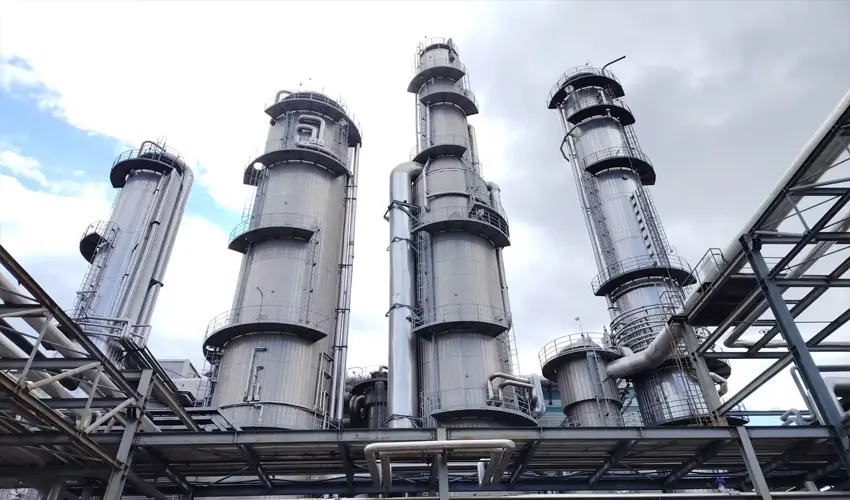
A well-designed continuous fermenter should be sized to match the distillation column throughput directly. When both sections run at steady state, surge tanks become unnecessary and heat integration becomes straightforward. The fermented mash, still hot from fermentation, feeds directly to the beer column, reducing the steam load for preheating.
The energy cascade opportunity is substantial. In plants we have configured, waste heat from distillation overhead vapor is used to preheat fermentation feed and to drive evaporators that concentrate thin stillage for DDGS drying. This closed heat loop can cut total plant steam consumption by 25 percent compared to plants where fermentation and distillation are thermally decoupled. The result is not just lower fuel bills; it reduces boiler size and cooling tower load for a new plant, improving the capital cost outlook.
Continuous fermentation also simplifies molecular sieve dehydration because the ethanol concentration in the feed to rectification is remarkably stable. In a batch system, ethanol concentration rises over the cycle, requiring the distillation control system to continually adjust reflux ratios. A continuous fermenter delivering consistent beer concentration lets you tune the rectification column once and operate it at its most efficient setpoint for months. This is one of those underappreciated advantages that shows up in lower steam consumption per liter of anhydrous ethanol.
Corn alcohol economics live and die on co-product value. Every ton of corn brings roughly one-third starch that becomes ethanol, while the remaining two-thirds leave as stillage, CO2, and—if the plant is designed right—biogas and liquid CO2. The fermentation tank design influences all of these streams.
Thin stillage handling begins at the fermenter discharge. The more consistent the ethanol and residual solids, the easier it is to size centrifuges and evaporators without overdesign. In a continuous system, we can keep solids content in the discharge within a narrow band, which lets the DDGS dryer operate close to its design capacity rather than cycling between overload and underload. The result is drier DDGS with less energy per ton—a direct margin gain.
CO2 recovery likewise benefits from steady operation. Fermentation off-gas in a continuous tank has a consistent carbon dioxide concentration and low oxygen content, which simplifies purification for food-grade liquid CO2 production. The same logic applies to wastewater: a stable stillage composition makes anaerobic digestion predictable, increasing biogas yield per cubic meter of waste.
Our approach treats the ethanol plant as a circular economy loop: corn becomes ethanol, protein feed, industrial CO2, and biogas, with nothing leaving the plant as waste. The fermenter is the start of that material flow chain. When it operates in steady state, every downstream unit operates closer to its nameplate efficiency. That is the strategic argument for continuous design—not just more ethanol, but more value from every processing step.
Before committing to a specific design, plant developers should walk through a few diagnostic questions with their engineering partner. These are the ones I raise in initial feasibility discussions.
What is the expected corn quality variation? If the plant will receive grain from multiple regions with wide protein and starch swings, a simpler tank design with external yeast recycle offers more operating flexibility than an intricate cascade. If corn quality is locked in through a single-supply contract, a multi-stage cascade can squeeze out higher yield.
How much automation is the operations team ready to manage? Continuous fermentation rewards automated monitoring—in particular, online ethanol sensors and redox potential probes that detect early signs of contamination—but it also demands that operators trust the instrumentation during night shifts. Systems with fewer moving parts, like a single chemostat with external recycle, are easier to commission and require less daily intervention.
What is the co-product strategy? A plant planning to sell food-grade CO2 and high-protein DDGS needs fermentation stability more than marginal ethanol gains. The tank design should prioritize steady-state output over peak yield. If the business case hinges on maximizing ethanol per bushel, a cascade that pushes conversion higher may justify the extra capital.
For project developers evaluating turnkey solutions, it is worth looking at engineering firms that can deliver the fermenter, distillation, and energy integration as one coordinated package. That way, the thermal cascade and mass balance are designed together, not stitched together later. Our team at AGRIFAM has structured several corn alcohol projects this way, and the difference in commissioning ramp-up time alone is measurable.
If you are developing a corn alcohol plant and need to confirm which fermentation architecture best matches your feedstock, throughput, and co-product mix, reach out at bjhn@agrifamgroup.com or call 010-8591 2286. We will walk through your specific parameters and map out the process configuration before you commit to equipment.
For a single-tank chemostat processing corn mash at 32–35 degrees Celsius, expect 24 to 36 hours. Adding external yeast recycle typically cuts that to 12–20 hours. Multi-stage cascades distribute the total residence time across tanks and can operate in the 15 to 30-hour range depending on the number of stages. The target is complete sugar utilization without bacterial contamination, so the optimum is site-specific.
Viability depends on a low-stress environment: steady pH, controlled temperature, and enough dissolved oxygen for yeast cell membrane synthesis. Most plants add a small aerobic yeast propagation side stream that continuously injects fresh, active yeast into the main fermenter. Sterilization of the incoming corn mash is mandatory—bacterial infection consumes sugars and produces organic acids that suppress yeast faster than any single design flaw.
It can, but with more operator intervention. Switching from corn mash to wheat or sorghum mash changes viscosity, sugar profile, and nutrient availability, which can upset the steady state. In plants that run two feedstocks seasonally, we design the fermenter with adjustable impeller speed and multiple feed points. The yeast adaptation window typically takes three to five residence times before ethanol production stabilizes on the new feedstock. Share your planned feedstock mix with us at bjhn@agrifamgroup.com and we can evaluate which configuration avoids excessive downtime between campaigns.
If you’re interested, check out these related articles:
Driving Global Food Conservation Through Technological Innovation






bjhn@agrifamgroup.com