EN
Establishing a high-yield industrial facility for fuel ethanol production from corn requires a deep understanding of multi-stage agricultural processing, chemical conversion, and advanced thermal separation. Modern bioethanol facilities must balance raw material preservation, enzyme efficiency, and energy-saving distillation to maintain profitability in a volatile energy market. By integrating heavy-duty grain storage, precise starch liquefaction, continuous fermentation, and molecular sieve dehydration, agricultural processors can maximize the conversion rate of every bushel of corn. This complete process analysis details the technical specifications, equipment configurations, and circular economy models required to build and operate a modern, energy-efficient corn-to-ethanol plant.
The efficiency of any corn-to-ethanol facility begins at the receiving gate. Raw corn arriving at the plant contains impurities such as dust, cob fragments, stones, and metal debris that can damage downstream milling machinery and reduce fermentation efficiency. Implementing a professional grain depot storage soultion is the first line of defense in maintaining feedstock quality. High-capacity commercial facilities utilize thermal-insulated steel silos equipped with automated mechanical ventilation, temperature monitoring, and nitrogen-regulated atmospheres to prevent grain spoilage, insect infestation, and dry matter loss.
Downstream processing equipment, especially high-speed hammer mills and slurry pumps, is highly vulnerable to abrasive wear from foreign materials. To safeguard these assets, plants deploy a multi-stage cleaning system before the milling stage. This system relies on specialized corn purification equipment, including rotary screens for size-based separation, magnetic separators to capture ferrous metals, and aspirators to remove light dust and chaff. By removing these contaminants, the plant protects the grinding plates and pump impellers, reducing maintenance downtime and stabilizing the particle size distribution of the corn flour.
Once purified, the corn undergoes dry milling to reduce the grain to a fine flour, a process known as corn crushing for ethanol. The particle size of the corn flour must be carefully controlled; if the grind is too coarse, the starch remains trapped within the endosperm matrix, reducing the corn-to-ethanol conversion rate. Conversely, if the grind is too fine, it increases the viscosity of the slurry, leading to mixing difficulties and higher electricity consumption in the slurry pumps. The optimal particle size typically ranges between 0.5 and 1.5 millimeters, with a moisture content maintained below 15% to facilitate efficient enzymatic hydrolysis.
During my fifteen years managing integrated agricultural infrastructure projects, I have observed that raw grain quality preservation is the single most overlooked factor in fuel ethanol yield optimization. In our engineering work for the corn ethanol project in Bolivia, we integrated advanced thermal-insulated steel silos to maintain grain moisture below 14.5%, which successfully eliminated localized heating and starch degradation during storage, directly protecting the fermentation feedstock.
After dry milling, the corn flour is mixed with process water and recycled thin stillage to form a slurry. This slurry undergoes starch liquefaction and saccharification, a two-step enzymatic process that breaks down complex starch polymers into fermentable simple sugars. In high-capacity corn deep processing facilities, this conversion is highly automated to maintain precise temperature, pH, and enzyme activity, often integrating advanced corn starch processing soultion technologies to optimize starch yield before fermentation.

The conversion of insoluble starch into glucose requires a precise addition of specialized enzymes. During the first stage, a high-temperature alpha-amylase, acting as the primary liquefaction enzyme for ethanol, is added to the slurry at temperatures between 80°C and 90°C. This enzyme breaks the alpha-1,4-glucosidic bonds, reducing the viscosity of the gelatinized starch. The optimal dosage of alpha-amylase typically ranges from 0.02% to 0.05% of dry solids, depending on the starch content of the corn. In the second stage, the slurry is cooled to approximately 60°C, and glucoamylase, serving as the saccharification enzyme ethanol, is introduced to hydrolyze the liquefied starch into glucose. The dosage of glucoamylase is carefully calibrated to between 0.04% and 0.08% of dry solids to maximize fermentable sugar yield while avoiding excess residual sugars that can inhibit yeast activity.
Once saccharification is complete, the glucose-rich mash is transferred to the ethanol fermentation tank. Modern industrial facilities prefer continuous fermentation technology over batch processing due to its higher volumetric productivity and lower labor requirements. A continuous fermentation system utilizes a series of interconnected fermenters where yeast is maintained in an active, high-density state.
Yeast management is critical during the alcohol fermentation process. The temperature of the fermenters must be strictly regulated between 30°C and 32°C, as temperatures exceeding 35°C can cause yeast stress, leading to premature cell death and increased production of organic acids. Additionally, maintaining a low pH (around 4.0 to 4.5) inhibits bacterial contamination without affecting yeast performance. By optimizing yeast propagation and nutrient feed rates, plants can achieve high ethanol concentrations (12% to 15% by volume) in the beer well, establishing an efficient base for downstream distillation.
The fermented mash, or beer, contains approximately 12% to 15% ethanol, with the remainder consisting of water, dissolved solids, and yeast cells. Extracting pure fuel grade ethanol from this mixture requires a highly efficient thermal separation process. This is achieved through a multi-column ethanol distillation process, which typically includes a beer column, a rectifying column, and a stripping column.
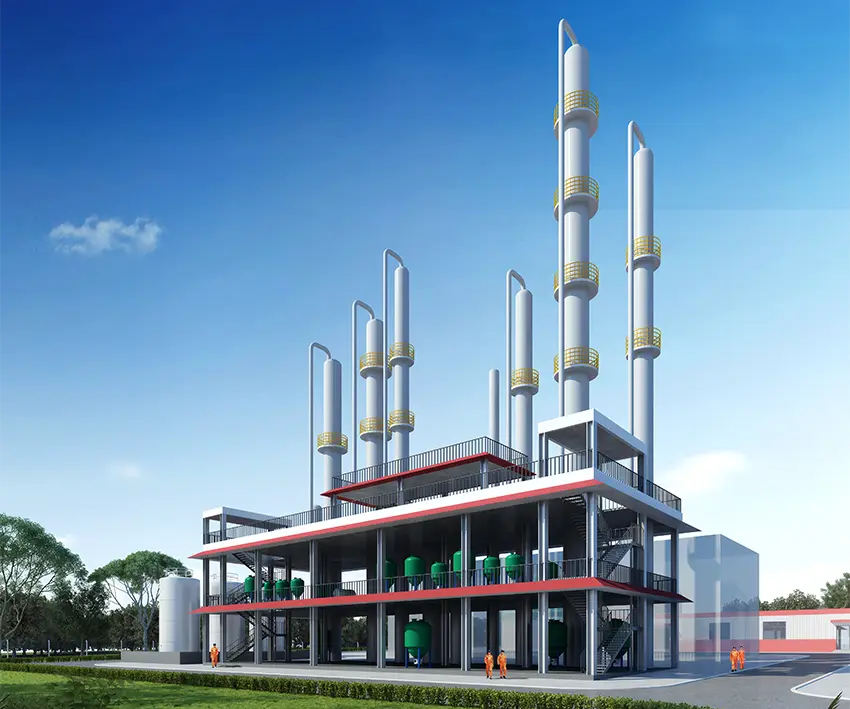
The beer column strips the volatile ethanol and water from the non-volatile solids, producing a vapor containing about 50% ethanol. This vapor enters the rectifying column, where it is concentrated to approximately 95% purity. However, conventional distillation cannot exceed this concentration because ethanol and water form a minimum-boiling azeotrope at 95.6% ethanol by weight.
To overcome the azeotropic limit without using toxic chemical entrainers like benzene or cyclohexane, modern plants utilize a molecular sieve dehydration unit operating on Pressure Swing Adsorption (PSA) technology. This system utilizes synthetic 3A molecular sieves, which are crystalline aluminosilicates with a precise pore diameter of 3 Angstroms. Because water molecules have a kinetic diameter of approximately 2.6 Angstroms, they can enter the pores and are adsorbed onto the zeolite surface. Ethanol molecules, with a kinetic diameter of 4.4 Angstroms, are too large to enter the pores and pass directly through the bed as anhydrous vapor. The system operates continuously using at least two adsorption beds: while one bed is actively dehydrating the ethanol vapor under high pressure, the other bed is regenerated under vacuum, using a small portion of the superheated anhydrous ethanol vapor to sweep out the adsorbed moisture.
This dehydration process yields anhydrous alcohol with a purity exceeding 99.5%, fully satisfying the fuel grade ethanol specifications mandated by international standards such as ASTM D4806 and EN 15376.
To reduce the high thermal energy demand of distillation and dehydration, modern plants implement energy cascade utilization. By integrating waste heat recovery systems, the hot overhead vapors from the distillation columns are used to preheat the incoming beer feed and drive the evaporators for the thin stillage. Implementing this thermal integration can reduce the overall steam consumption of the distillation and dehydration sector by up to 25%, significantly lowering the operating costs of the fuel ethanol alcohol production soultion.
If your project involves establishing a new corn alcohol manufacturing facility, discussing the thermal integration parameters and molecular sieve sizing before committing to a specific equipment layout is highly recommended.
A modern fuel ethanol plant cannot survive on ethanol sales alone. To secure long term profitability and environmental compliance, plants must adopt a circular economy model that achieves near-zero waste through the complete utilization of all fermentation by-products. This closed-loop industrial chain transforms what was once considered waste into high-value revenue streams, specifically DDGS protein feed, food-grade liquid CO2, and biogas.
The solid residue remaining after distillation, known as whole stillage, is processed to separate the liquid thin stillage from the wet grains. The wet grains are mixed with concentrated syrup from the evaporators and dried to produce Distillers Dried Grains with Solubles (DDGS). This DDGS protein feed is a highly valued, nutrient-rich animal feed containing approximately 26% to 30% crude protein, 10% fat, and high concentrations of digestible fiber. It serves as an excellent protein and energy source in a modern dairy cow ranch soultion, a high-yield beef cattle ranch soultion, or an advanced sheep farm intelligent soultion. By supplying this feed directly to local livestock operations, ethanol plants establish a strong agricultural-industrial integration that reduces regional feed costs.
Another major by-product is the carbon dioxide gas generated during yeast fermentation. For every gallon of ethanol produced, approximately 6.6 pounds of CO2 are released. Instead of venting this greenhouse gas into the atmosphere, modern facilities install a food-grade liquid CO2 recovery system. The raw fermentation gas is scrubbed with water to remove trace ethanol, passed through activated carbon beds to eliminate volatile organic compounds, and compressed and liquefied to produce ultra-pure CO2 (99.9% purity). This recovered gas is sold directly to the food and beverage industry for carbonation, flash freezing, and protective atmosphere packaging.
Finally, the liquid wastewater from the evaporators and plant cleaning cycles undergoes anaerobic digestion. This biological treatment process utilizes specialized bacteria to break down organic matter, producing a methane-rich biogas. This biogas is captured and utilized as a renewable fuel in the plant’s steam boilers, displacing up to 15% of the natural gas required for distillation and drying. The treated water is recycled back into the slurry preparation stage, establishing a zero-liquid-discharge system that minimizes fresh water consumption. This complete circular integration is detailed in our strategic analysis on Driving Global Food Conservation Through Technological Innovation.
Developing a commercial corn-to-ethanol facility is a highly complex capital investment that requires seamless coordination across multiple engineering disciplines. From the initial feasibility study to final commissioning, every stage of the project must be meticulously managed to control costs, secure regulatory permits, and guarantee that the plant meets its designed production capacity.
A successful bioethanol factory setup begins with a detailed technical and economic assessment. This includes analyzing regional grain supply chains, evaluating local utility infrastructure, and modeling the ethanol production cost breakdown. Raw materials (primarily corn) typically account for 60% to 70% of the total operating expenses, followed by energy costs for steam and electricity. To optimize the corn ethanol project ROI, developers must select an experienced engineering partner capable of delivering a complete turnkey solution.
Modern facilities rely heavily on advanced automation to maintain process stability and minimize labor costs. Implementing a centralized Distributed Control System (DCS) permits operators to monitor and adjust key parameters such as slurry pH, fermenter temperatures, and molecular sieve pressure swings in real-time. By integrating an intelligent digital management platform, plant managers can track energy consumption, predict equipment maintenance needs, and optimize chemical dosing, directly increasing the plant’s overall operational uptime.
AGRIFAM Co., Ltd. has established a strong global track record in executing large-scale agricultural and deep-processing engineering projects. In our corn ethanol project in Bolivia, we delivered a complete, one-stop engineering solution covering silo storage, milling, fermentation, and distillation systems, tailored to the regional climate and feedstock characteristics. Similarly, during our execution of the fuel ethanol project in China (specifically our alcohol project in Heilongjiang, Qiqihar), our team integrated advanced energy cascade utilization and waste heat recovery systems, successfully reducing the plant’s steam consumption by 25% compared to conventional designs. Our turnkey capabilities guarantee that every project is delivered on schedule, within budget, and in full compliance with international environmental and quality standards.
The table below outlines the critical design parameters and equipment recommendations for a standard 100,000-ton-per-year fuel ethanol plant:
| Process Stage | Key Equipment | Critical Design Parameter | AGRIFAM Recommended Solution |
|---|---|---|---|
| Grain Storage | Thermal-Insulated Steel Silo | Moisture content < 14.5% | Thermal-Insulated Silo with automated aeration |
| Purification | Rotary Screen & Aspirator | Dust removal efficiency > 99% | Heavy-duty multi-stage cleaning system |
| Milling | Hammer Mill | Particle size 0.5 – 1.5 mm | High-speed crushing mill with automated screen change |
| Fermentation | Ethanol Fermentation Tank | Temperature 30°C – 32°C | Continuous fermentation system with external cooling |
| Dehydration | Molecular Sieve Unit | Water content < 0.2% | Two-bed PSA system with 3A synthetic zeolites |
| By-Product Drying | Ring Dryer / Rotary Dryer | DDGS moisture < 10% | Energy-integrated steam tube dryer |
Establishing a highly efficient fuel ethanol production facility requires balancing raw material quality, advanced chemical conversion, and rigorous energy integration. Developers frequently struggle with high energy consumption, unstable fermentation yields, and complex equipment integration across multiple suppliers. AGRIFAM Co., Ltd. addresses these challenges by delivering integrated, one-stop engineering solutions from initial consulting and design to manufacturing, installation, and full plant commissioning. Contact our system integration specialists at bjhn@agrifamgroup.com or call 010-8591 2286 to discuss your project specifications and secure a customized technical proposal.
In a modern dry-mill facility, the standard corn-to-ethanol conversion rate is approximately 2.8 to 2.9 gallons of anhydrous ethanol per bushel of corn (56 pounds of corn at 15% moisture). This conversion efficiency relies heavily on optimizing particle size during corn crushing for ethanol and maintaining precise enzyme dosages during starch liquefaction and saccharification. Additionally, every bushel yields valuable co-products, including approximately 15 to 17 pounds of DDGS protein feed and 15 to 17 pounds of captured carbon dioxide, making dry milling the preferred process for commercial bioethanol production.
To meet international blending standards, fuel grade ethanol must comply with strict specifications defined by ASTM D4806 or EN 15376. The primary parameter is water content, which must be maintained below 1.0% by volume (and commercially targeted below 0.2% to prevent phase separation in gasoline blends). Other critical parameters include a minimum ethanol content of 92.1% by volume for denatured fuel ethanol, low acidity (calculated as acetic acid), and strict limits on inorganic chlorides, copper, and sulfur. Achieving these ultra-pure standards requires a high-performance molecular sieve dehydration unit.
Continuous fermentation technology offers significant advantages over traditional batch processing for large-scale fuel ethanol production. By continuously feeding fresh mash into a series of interconnected fermenters and maintaining a constant yeast density, continuous systems achieve up to 30% higher volumetric productivity and require smaller ethanol fermentation tank volumes for the same annual capacity. This continuous operation minimizes downtime for cleaning and sterilization, lowers labor costs, and stabilizes downstream distillation column operation. For detailed feasibility assessments and customized machinery layouts, speaking with our technical engineering team at AGRIFAM Co., Ltd. is the most reliable way to clarify your specific plant requirements.
If you’re interested, check out these related articles:
Driving Global Food Conservation Through Technological Innovation







bjhn@agrifamgroup.com