EN
Running a feed mill that actually performs means getting the engineering right from the start. I’ve seen operations struggle for years with layouts that looked good on paper but created bottlenecks nobody anticipated. The difference between a profitable feed mill and one that bleeds money often comes down to decisions made before the first concrete was poured. Agrifam Co., Ltd. works across the full spectrum of feed mill engineering solutions, from early concept through commissioning and beyond, supporting livestock and aquafeed producers who need their facilities to deliver results in an industry that keeps raising the bar.
A feed mill plant built for efficiency starts with design principles that anticipate how the facility will actually run, not just how it looks in a rendering. Modular design matters here because it lets you scale without tearing everything apart. When you phase construction intelligently, initial capital stays manageable while expansion remains straightforward. The layout itself drives energy consumption more than most operators realize. A well-optimized plant layout can cut energy use by 15-20%, which compounds into serious savings over a facility’s lifetime. These feed mill engineering solutions prioritize flow, minimize redundant handling, and position equipment where it makes operational sense.
Getting ingredients into the plant and stored properly sounds basic, but this is where many operations lose money before production even starts. Automated intake and storage systems reduce contamination risk and prevent spoilage that erodes margins. Proper storage practices alone can reduce raw material losses by 5-10%. The systems we implement focus on maintaining ingredient integrity from arrival through processing, because feed quality starts with what goes into the mill.
Particle size distribution affects everything downstream, from pellet quality to animal performance. Hammer mills and roller mills each have their place depending on ingredient characteristics and target specifications. The goal is achieving the particle size that optimizes digestibility for the species you’re feeding. Mixing precision matters just as much. Modern mixing systems achieve nutrient uniformity within 98% accuracy, which translates directly to consistent animal performance across batches.
Livestock and aquatic species have fundamentally different needs, and the processing equipment reflects that. Pelleting works well for most livestock feed, improving digestibility and reducing dust losses during handling. Aquafeed production typically requires extrusion technology because water stability determines whether the feed actually gets consumed. Extruded aquafeed can improve Feed Conversion Ratio by 10-15%, which represents significant economic value in aquaculture operations where feed costs dominate production economics.
| Feature | Pelleting for Livestock | Extrusion for Aquafeed |
|---|---|---|
| Primary Benefit | Improved digestibility, reduced dust, better handling | High water stability, enhanced digestibility, floating feed |
| Process Temp. | Moderate (70-90°C) | High (100-150°C) |
| Pressure | Moderate | High |
| Product Density | High | Variable (floating or sinking) |
| FCR Impact | Improved | Significantly improved (10-15% for aquafeed) |
The feed mills being built today look nothing like facilities from even a decade ago. IoT sensors and AI-driven analytics enable predictive maintenance that catches problems before they cause downtime. Automation reduces labor costs by 25-30% while increasing throughput by 15-20%. These aren’t theoretical improvements. They show up in operating statements.
Automated dosing, mixing, and bagging systems remove the variability that comes with manual operations. Consistency improves because machines don’t get tired or distracted. Real-time data analytics identify production bottlenecks 30% faster than traditional monitoring approaches, which means problems get solved before they cascade into larger issues. These feed mill engineering solutions integrate intelligent systems that learn from operational data and continuously optimize performance.
Feed safety regulations keep tightening, and the consequences of non-compliance have grown more severe. HACCP principles form the foundation, but advanced analytical equipment provides the verification. Near-Infrared spectroscopy and High-Performance Liquid Chromatography enable continuous quality monitoring that catches issues before product ships. Robust quality control systems reduce product recalls by over 90%, protecting both animal health and the reputation you’ve built with customers. Traceability systems ensure accountability throughout the supply chain.
《Driving Global Food Conservation Through Technological Innovation》
Turnkey feed mill projects require coordination across dozens of disciplines and vendors. Agrifam provides integrated project management that covers everything from financial structuring to commissioning and subsequent upgrades. This comprehensive approach reduces project timelines by 20% and cost overruns by 10% compared to fragmented management structures.
Feed plant development involves sequential decisions where early choices constrain later options. Getting the feasibility study right can save up to 15% in overall project costs because it prevents expensive mid-project corrections. We manage design, civil engineering, equipment manufacturing, installation, and commissioning as a unified process rather than disconnected phases. This integration eliminates the gaps where problems typically hide.
Initial construction represents only part of a feed mill’s total cost of ownership. We provide support for feed mill financing that aligns capital structure with cash flow realities. Ongoing upgrade services keep facilities competitive as technology advances. Regular upgrades can extend plant lifespan by 20% while maintaining the operational edge that justifies the original investment.
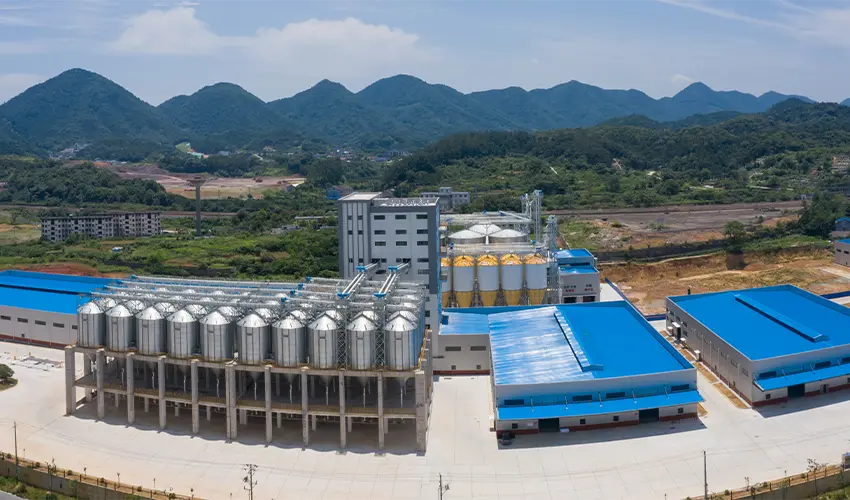
Environmental responsibility has moved from nice-to-have to operational necessity. Energy-efficient equipment and waste heat recovery systems address the environmental impact of feed mills while improving economics. Implementing sustainable practices can reduce operational costs by 10-15% and strengthen market position with customers who care about supply chain sustainability.
Variable frequency drives, LED lighting, and water recycling systems each contribute to resource efficiency. Energy-efficient motors can save up to 30% on electricity costs, which adds up quickly in operations that run around the clock. These investments typically pay back faster than operators expect, making environmental performance and financial performance align rather than conflict.
Dust collection, wastewater treatment, and noise dampening protect both environmental compliance and relationships with neighbors. Environmental violations carry substantial fines, but the reputational damage often costs more than the penalties. Effective pollution control demonstrates the kind of operational discipline that customers and communities expect from modern feed mill engineering solutions.
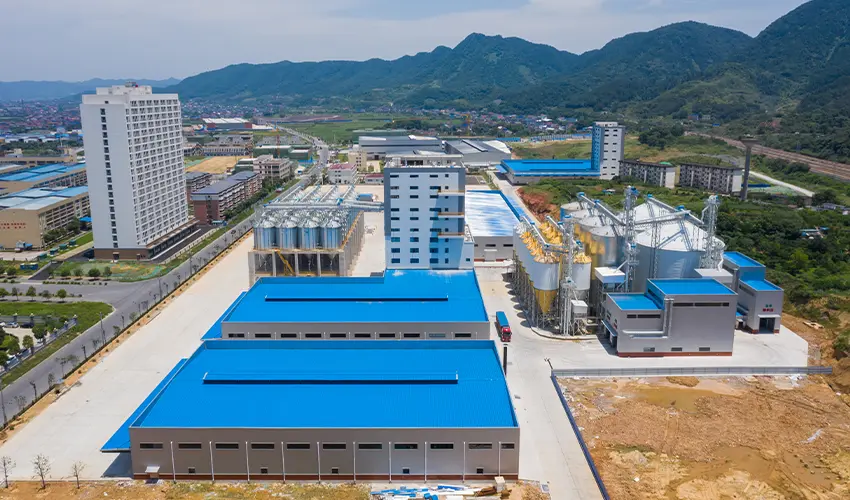
The agricultural industry keeps changing, and feed mills need flexibility to respond. Agrifam builds facilities designed for adaptation, supporting integrated solutions that connect farm operations to end markets. Companies that invest in flexible, modular systems are 40% more likely to adapt successfully to market shifts. This approach protects investments against uncertainty.
AI-driven analytics optimize feed formulations based on ingredient availability and pricing, predict equipment failures before they cause downtime, and streamline supply chain decisions. Predictive maintenance alone can reduce downtime by 70%, which represents significant capacity recovery in facilities running near full utilization. These intelligent systems become more valuable as they accumulate operational data.
Multi-species production lines and quick changeover capabilities let operators respond to market opportunities rather than watch them pass. The ability to switch between different feed types efficiently can increase market reach by 25%. Feed mill engineering solutions that prioritize flexibility create options that operators can exercise when conditions favor them.
A modern feed mill integrates raw material intake and storage, grinding and mixing systems, pelleting or extrusion lines, cooling and crumbling equipment, screening, bagging, and quality control laboratory facilities. Automation and digital control systems tie everything together, enabling the real-time monitoring and adjustment that drives operational efficiency and product consistency.
Automation reduces manual labor requirements and eliminates the inconsistency that comes with human operation. Precise ingredient dosing and consistent mixing produce uniform feed composition batch after batch. Real-time monitoring catches deviations before they affect product quality. The combined effect is higher throughput, lower operating costs, and feed that performs predictably for the animals consuming it.
Energy consumption deserves primary attention because it represents both the largest environmental impact and the largest operating cost. Efficient equipment selection and waste heat recovery address this directly. Dust collection and wastewater treatment systems protect air and water quality while maintaining regulatory compliance. Noise control matters for community relations. Material selection and waste management practices round out a comprehensive environmental approach.
Agrifam offers financial support as part of comprehensive project services, including assistance with project financing structures, investment planning, and economic feasibility analysis. The goal is ensuring projects make financial sense before construction begins, not just technical sense. This integrated approach helps clients build facilities that perform economically over their full operating life.
Long-term success requires facilities that can adapt as markets and technology evolve. Modular designs accommodate future expansion without requiring fundamental reconstruction. Advanced automation provides efficiency advantages that compound over time. Ongoing upgrade services keep facilities current with technological advances. The focus on adaptable, integrated solutions means feed mills remain competitive as customer demands diversify and industry standards rise.
Partner with Agrifam Co., Ltd. for comprehensive expertise in feed mill engineering solutions. Our integrated services span financial consultation, advanced manufacturing, and ongoing operational support, all designed to help livestock and aquafeed producers achieve efficiency, sustainability, and profitability targets. Contact us to discuss your project requirements and learn how our engineering approach can strengthen your operations.
Email: bjhn@agrifamgroup.com | Phone: 010-8591 2286






bjhn@agrifamgroup.com