EN
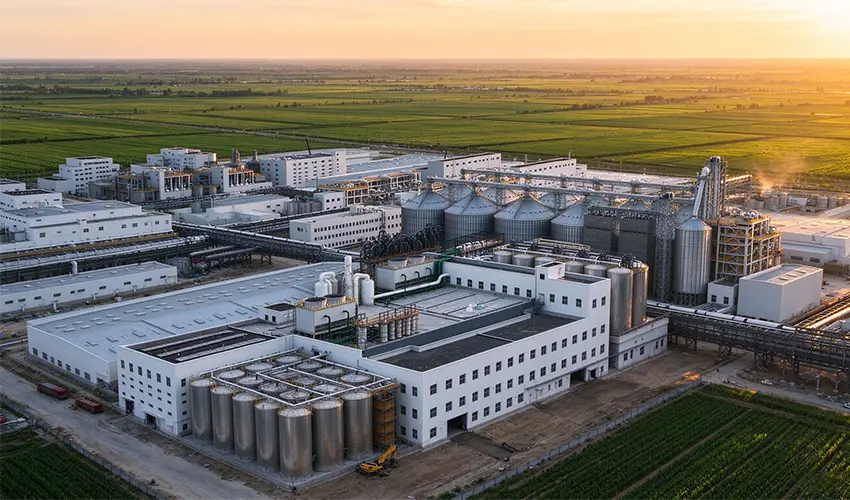
AGRIFAM provides turnkey lysine smart-factory solutions based on advanced fermentation engineering, refined extraction/purification, and intelligent control—covering strain culture, fermentation control, membrane separation, ion-exchange purification, concentration/crystallization, and drying/granulation.
Using starch-based feedstock, the line produces high-purity lysine from fermentation broth via membrane separation and ion exchange, followed by crystallization and drying, with flexible supply of feed-grade, food-grade, and pharmaceutical-grade products. DCS enables online control of key fermentation and extraction parameters for batch stability and process repeatability. AGRIFAM helps customers convert feedstock into lysine supply for animal feed, food fortification, dietary supplements, and pharmaceuticals—forming a scalable manufacturing platform with controllable conversion, consistent quality, multi-grade flexibility, energy savings, and cost efficiency.
AGRIFAM aims to be a trusted turnkey partner for lysine smart factories.
 Intelligent control
The digital management platform precisely optimizes production parameters are precisely optimized by digital management platform to ensure stable quality and controllable costs.
Technological Strength Support
We possess mature core process technologies including liquefaction, saccharification, fermentation, ion exchange, concentration, crystallization, and drying, ensuring stable product quality and precise, controllable quality parameters.
Professional Team
We have a professional application technology team capable of providing customers with product selection advice, formulation optimization support, and problem-solving solutions.
Improve design efficiency
Effectively optimize the design process, precisely control material selection and usage, significantly shorten the design cycle, and avoid design deviations and material waste.
Liquid glucose, magnesium sulfate, potassium dihydrogen phosphate, liquid ammonia, and other raw and auxiliary materials, together with water, are subjected to high-temperature sterilization through a continuous sterilization system, and then the materials are cooled and sent to the fermentation tank. Before the first inoculation of the seed tank, the pipelines and culture medium must be sterilized. The bacterial suspension is inoculated into the primary seed tank and cultured with aeration and agitation, then cultured in the secondary seed tank with aeration and agitation. After microscopic examination shows normal conditions, it can be inoculated into the fermentation tank.
After high-temperature sterilization, the culture medium and nutrient salts are added to the fermentation tank. The lysine strain that has undergone two-stage culture is inoculated into the fermentation tank, and glucose is fed during the culture process. After fermentation culture, lysine fermentation broth is produced.
The fermentation broth enters the membrane system. The membrane system uses ceramic membrane filtration to remove mycelia, proteins, colloidal pigments, etc. After separation, the liquid phase enters an intermediate temporary storage tank as the feed liquid for ion-exchange column loading; the solid part is pumped to the lysine sulfate workshop for use.
The clear liquid of the fermentation broth is subjected to resin column adsorption and elution to extract lysine from the clear liquid, producing a lysine collection liquid.
The clear liquid undergoes concentration, crystallization, and other process steps to obtain 98.5% L-lysine hydrochloride crystals.
The L-lysine hydrochloride crystals are separated by a centrifuge and rinsed with soft water for decolorization, producing lysine hydrochloride crystals with uniform particles.
The L-lysine hydrochloride crystals enter a fluidized bed and are gradually dehydrated and dried. Larger particles enter a grinding mill for crushing and then enter the finished product storage tank.
Qualified materials entering the silo are bagged by a packaging machine, re-inspected, tied, sealed, coded, and metal-detected, and then palletized and warehoused by a robot.
bjhn@agrifamgroup.com