EN
CO2 recovery from fermentation transforms a greenhouse gas liability into a high-value commercial product, but the difference between a marginal side stream and a reliable revenue line rests on how thoroughly the recovery system is integrated into the ethanol plant from the outset. Over the past decade, I have seen integrated corn-to-ethanol projects where CO2 recovery was designed as part of the full-chain circular economy, and others where it was added later as a retrofit. The former consistently delivers higher CO2 purity, better energy efficiency, and access to food-grade markets that the latter struggles to meet. This article explains the capture and purification process, the specific quality thresholds required for commercial CO2, and the plant-wide integration decisions that make the difference between a cost and a revenue centre.
Every million litres of fuel ethanol produced releases approximately 0.75 tonnes of CO2 from fermentation. In a standalone ethanol plant, that CO2 is vented. In an integrated biorefinery operating on a corn-food-energy-feed model, it becomes a third revenue stream alongside ethanol and distillers grains.
The financial logic is straightforward. Food-grade liquid CO2 trades at multiples above fuel ethanol on a per-tonne basis. Industrial-grade CO2, while narrower in margin, still offsets a portion of the plant’s energy bill when the liquefaction and storage infrastructure is shared. We build our alcohol EPC projects around this principle from the feasibility stage. A plant designed with CO2 recovery as a core unit operation avoids the cost and compromise of retrofitting later. The utilities, plot space, pipe rack allocation, and control system architecture all account for it before foundation work begins.
More practically, vented CO2 is a missed opportunity in an industry where operating margins shift with grain and energy prices. An ethanol plant that fails to monetise its CO2 is leaving a predictable, high-concentration gas stream on the table. The purification cost to upgrade that stream to commercial specification is modest relative to the revenue it can generate when the right market offtake exists.
Fermentation off-gas at the top of the beer column is roughly 99% CO2 by volume on a dry basis, with the remaining fraction consisting of water vapour, ethanol carryover, and trace volatile organic compounds including aldehydes, esters, and sulfur species. The gas exits the fermenter at ambient pressure and near-saturation humidity. Direct compression from this state would produce an acidic, corrosive condensate that damages downstream equipment.
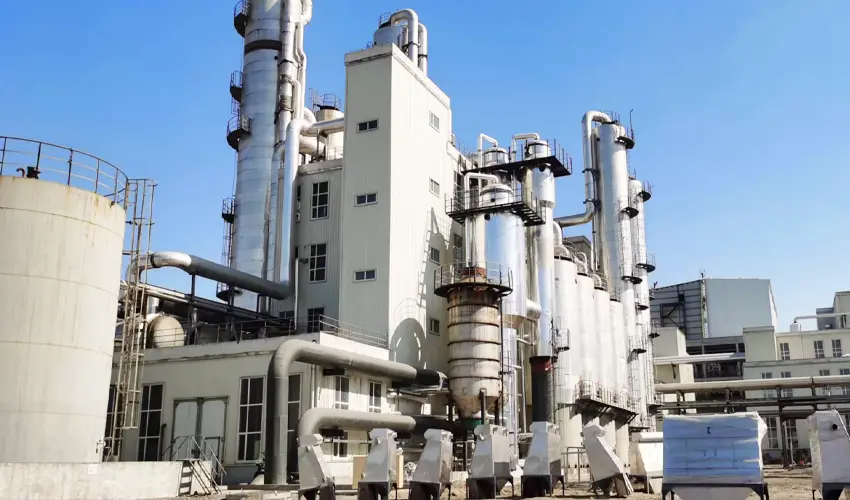
The conventional purification sequence runs as follows. A water scrubber first removes ethanol and most water-soluble organics, returning ethanol to the process. The gas then passes through an oxidiser or a catalytic bed to convert residual hydrocarbons and sulfur compounds such as hydrogen sulfide and dimethyl sulfide into species that can be removed in subsequent steps. Activated carbon beds or molecular sieve dryers take out moisture to a dewpoint below -60°C, after which the CO2 is compressed to 18–22 bar and fed into a liquefaction unit. The liquefaction system runs a closed ammonia or propane refrigeration loop to bring the CO2 to -20°C to -30°C. Non-condensable gases, mainly nitrogen and oxygen that entered with ambient air at various leak points, are purged.
For plants targeting food-grade CO2, an additional distillation column or stripper between the scrubber and the dryer separates light hydrocarbons and residual oxygenates. This step raises purity above 99.9% and eliminates off-taste and odour compounds that beverage producers routinely test for. Without it, the product is limited to industrial applications.
Not all recovered CO2 is equal, and the market price reflects the purification steps required. The table below summarizes the purity thresholds and typical applications for the three main commercial grades from a fermentation source.
| Grade | CO2 Purity (min.) | Key Contaminant Limits | Typical Market |
|---|---|---|---|
| Food-Grade (ISBT, EIGA) | 99.9% | Total sulfur <0.1 ppmv, non-condensables <0.5%, benzene <0.02 ppmv, acetaldehyde <0.2 ppmv | Carbonated beverages, dry ice for food transport, modified atmosphere packaging |
| Industrial-Grade | 99.5% | Total sulfur <1.0 ppmv, water <50 ppmv | Welding gas, water treatment pH control, greenhouse enrichment |
| Liquid CO2 (technical) | 99.0% | Water <100 ppmv, non-condensables <2% | Fire suppression, enhanced oil recovery, cryogenic cleaning |
I want to underscore the acetaldehyde limit. Fermentation-derived CO2 carries acetaldehyde as a characteristic trace impurity from yeast metabolism. Beverage customers test to low parts-per-billion thresholds because acetaldehyde at perceptible levels imparts a grassy, green-apple note that destroys neutral-flavour product quality. Stripping acetaldehyde to below 0.2 ppmv requires a dedicated separation step, typically a small distillation column running reflux with a side draw, or a low-temperature adsorption bed that selectively binds aldehydes. This single design decision often separates plants that sell into the food-grade market from those locked into industrial offtake contracts at lower prices.
Beyond chemical purity, food-grade certification requires HACCP documentation, batch traceability, and third-party audit of the packaging and loading systems. I have seen plants that met every chemistry specification but failed an ISBT audit because the truck-loading station lacked a dedicated vapour return line or the liquid CO2 storage tank material certification was incomplete. These are the practical, non-chemical requirements that a turnkey EPC project addresses by integrating quality systems from the engineering stage.
CO2 recovery consumes steam, electricity, and cooling water. How those utilities are sourced and balanced with the distillation and dehydration sections determines whether the CO2 plant operates at full capacity or only when there is surplus energy available. Running the CO2 liquefaction compressor on a dedicated motor is simple but adds to the plant’s peak electrical load. Running it on a steam turbine fed from the same medium-pressure header that supplies the rectification column reboiler introduces operational coupling between the two units.
If your facility was originally designed with CO2 recovery as part of the heat and mass balance, this coupling is manageable. The steam turbine exhaust can be cascaded to lower-pressure users such as the molecular sieve regeneration heater, reducing overall fuel consumption. We size the ammonia refrigeration system to match the peak fermentation gas flow during the highest-production months, with turndown capability for seasonal operation. The cooling tower and chilled water network are designed with the CO2 plant’s condenser duty in the initial load list, avoiding the need to add chillers later.
Retrofitting CO2 recovery into an existing ethanol plant is where I see the most project risk. The fermentation off-gas header may be undersized. The pipe rack may lack space for a new 6-inch or 8-inch stainless steel line. The electrical substation may not have a spare feeder of sufficient capacity for the liquefaction compressor. Each of these issues is solvable, but they add cost and schedule. A plant designed as an integrated unit from the start avoids these compromises.
If your project is at the feasibility stage, share the planned ethanol capacity and fermentation configuration with our team at bjhn@agrifamgroup.com. We can provide a utility load estimate that shows how CO2 recovery fits into the overall plant energy balance before you commit to major equipment.
The merchant CO2 market splits broadly into three segments: food and beverage, industrial gas, and emerging applications. Food and beverage commands the highest price but also the strictest quality and documentation requirements. Industrial CO2 is more forgiving on purity but sensitive to logistics cost, since it is a low-value, high-volume product where transportation distance is the single largest factor in delivered cost.
Dry ice production from liquid CO2 is a derivative market that offers higher value per kilogram and lower logistics sensitivity if the dry ice is used locally for cold chain distribution. Large poultry and meat processing facilities are consistent buyers, as are pharmaceutical cold chain operators. In Southeast Asia and Latin America, we see growing demand for dry ice in aquaculture cold chain, a market that did not exist at this scale ten years ago.
Greenhouse CO2 enrichment represents a smaller but higher-margin niche. Operators of controlled-environment vegetable and flower production inject CO2 to raise ambient concentrations from 400 ppm to 800–1200 ppm, increasing yield by 20–40% for crops such as tomatoes, cucumbers, and lettuce. The CO2 must be free of ethylene and other plant-growth-inhibiting trace gases, which aligns well with the purification capabilities of a well-designed fermentation CO2 plant.
The storage and distribution system rounds out the commercial picture. A bulk liquid CO2 storage tank of 50–100 tonnes capacity allows the plant to arbitrage between summer peak demand and winter low demand, smoothing cash flow across the year. Tanker loading stations with weighbridge integration and custody transfer metering are standard for any plant selling into the merchant market.
For ethanol plant operators evaluating which market segment to target, the decision usually comes down to location and available purification investment. A plant within 200 km of a beverage bottling hub should invest in the full food-grade purification train, because the logistics advantage supports a premium price. A plant in a remote agricultural region may find that industrial-grade CO2 sold into local welding and water treatment markets, combined with dry ice for agricultural cold chain, delivers better netback after transport costs. There is no single right answer, but there is a right answer for each specific project, and it is one we work through at the feasibility stage. Contact our engineering team at bjhn@agrifamgroup.com or call 010-8591 2286 to discuss your plant’s specific circumstances and we will confirm the optimal CO2 recovery configuration for your capacity and target market.
In our project experience, a CO2 recovery plant integrated into a new-build 200,000-tonne-per-year fuel ethanol facility typically achieves a simple payback of 3 to 5 years, assuming food-grade liquid CO2 offtake at prevailing market prices. The variation depends on electricity cost, the level of purification (food-grade vs. industrial), and the distance to the nearest CO2 customer. Standalone industrial-grade recovery with no food-grade treatment pays back faster on capital but generates lower annual revenue. The highest net present value over 15 years comes from food-grade production with a diversified customer portfolio that includes beverage, dry ice, and greenhouse segments.
Yes, in most jurisdictions the CO2 recovery plant requires its own environmental permit addendum and, for food-grade production, a food safety registration separate from the ethanol plant’s operating licence. The CO2 product is classified as a food additive (E290) and must comply with local food safety regulations. We work with clients to integrate permitting into the overall project schedule so that the CO2 plant commissioning aligns with the regulatory approvals timeline.
It depends on the original plant layout and available utilities. If the fermentation off-gas collection header is accessible and the pipe rack has spare capacity, a tie-in during a scheduled turnaround is feasible. However, if the distillation area is congested or the electrical infrastructure is at capacity, a retrofit can require significant civil and electrical work that extends beyond a routine shutdown. We assess these constraints during the technical feasibility study and recommend whether a retrofit or a phased integration approach makes more sense for the specific site.
Fermentation upsets that produce elevated levels of secondary metabolites, such as higher alcohols or organic acids, increase the contaminant load in the off-gas. The downstream purification train is designed with monitoring instrumentation that detects these excursions and can divert off-spec CO2 to the vent until the fermentation stabilises. The product storage tank buffer, typically sized for 24 to 48 hours of production, allows continuous delivery to customers even during short-duration process upsets, provided the purification system returns to specification within that window.
Below an ethanol production capacity of approximately 100,000 tonnes per year, the capital cost of the purification and liquefaction equipment becomes difficult to justify on CO2 revenue alone unless a premium local market exists for dry ice or greenhouse CO2. At smaller scales, we sometimes recommend a partial recovery system that captures the CO2 for on-site use, such as pH control in wastewater treatment or algae cultivation, rather than pursuing merchant sales. If your plant is below this threshold but you have a specific commercial offtake in mind, send your current production data and target market information to bjhn@agrifamgroup.com. We can run a preliminary economic assessment to see if a custom configuration changes the equation.
If you’re interested, check out these related articles:
Driving Global Food Conservation Through Technological Innovation







bjhn@agrifamgroup.com