EN
Electronic-grade anhydrous ethanol is not a standard alcohol product. For semiconductor fabs, a single stray metal ion at the parts-per-billion level can compromise an entire wafer batch. As an agricultural industry chain strategist, I have seen integrated alcohol production systems evolve from producing fuel-grade ethanol to meeting the ultra-high purity demands of electronics manufacturing. Achieving that purity requires a tightly controlled production chain, from grain selection to molecular sieve dehydration and finished product handling. Most planning discussions focus on end-user specifications, but the larger challenge sits further upstream: engineering the full production system to deliver consistently pure anhydrous ethanol for chip industry applications.
Semiconductor manufacturers operate to impurity limits far tighter than reagent or pharmaceutical grades. Electronic-grade anhydrous ethanol typically must contain less than 10 parts per billion of alkali metals, less than 1 ppb of transition metals, and essentially no particulate larger than 0.2 micron. These thresholds are not aspirational targets. A single high-sodium lot can etch irregularly, shift doping profiles, or leave post-clean residues that kill yield. In project planning, we treat the purification circuit not as a standalone add-on but as the core design constraint that drives everything from tank material selection to cleanroom-compatible filling stations.
| Grade | Purity Target | Key Impurities (max) | Typical Application |
|---|---|---|---|
| Electronic | 99.99%+ | Na, K <10 ppb; Fe, Cu <1 ppb | Wafer cleaning, solvent |
| HPLC/Reagent | 99.9%+ | Metals <1 ppm | Analytical chemistry |
| USP/EP Medical | 96-99.5% | Methanol, aldehydes | Disinfectant, extraction |
| Fuel | ≥99.5% | Water, denaturant | Gasoline blending |
Such levels cannot be met by simply extending column length or adding another distillation stage. The entire process water loop, from corn steeping to fermentation, becomes part of the contamination control chain. Even the choice of piping alloy matters. We have learned that 316L stainless steel with electropolished surfaces is the minimum, and in the most sensitive post-dehydration sections, perfluoroalkoxy polymer linings eliminate metal migration almost entirely.
Anhydrous ethanol at any purity grade requires breaking the ethanol-water azeotrope. Pressure swing adsorption over 3A molecular sieves remains the industry workhorse, but for electronic-grade product, the sieve bed operation shifts from simple dryness to trace impurity exclusion. The bed regeneration cycle, normally optimized for energy cost, must be managed to avoid accumulating sodium, calcium, or other ions that slowly leach into the product stream. We have found that batch bed polishing with a second, deeper-bed sieve stage, coupled with conductivity-monitored regeneration, cuts metal carryover by an order of magnitude. The additional capital cost is modest when viewed against the yield risk of a contaminated solvent reaching the fab floor.
Distillation column design also shifts. A standard fuel ethanol rectification column produces 95-96% ethanol overhead. To hit 99.9% before the molecular sieve, the column needs a higher reflux ratio and structured packing rather than trays. Structured packing reduces liquid holdup and residence time, which in turn limits the formation of ethyl acetate or acetaldehyde condensation products that can appear as non-volatile residue. For plants targeting semiconductor-grade product, we typically spec 250Y or 350Y stainless packing and design the column for 30 theoretical stages or more.
Producing electronic-grade ethanol is a system problem more than a chemistry problem. Every pump seal, every heat exchanger gasket, every storage tank breather becomes a potential reintroduction point for contaminants that the distillation train just removed. We have seen projects where a brilliantly designed purification train delivered on-spec product to a storage tank, only for the tank’s carbon steel vent line to reintroduce rust particles. The fix was as simple as a 0.1-micron hydrophobic vent filter, but finding it required full-chain traceability.
A properly integrated plant implements clean-in-place protocols not just for tanks but for the entire product path from the surge drum after the molecular sieve to the drumming or isotainer loading station. Nitrogen blanketing is standard. Dedicated product pipes, color-coded and labeled, prevent cross-contamination. The instrumentation loop must include online total organic carbon analyzers and laser particle counters with alarms that automatically divert off-spec product. These details are not optional add-ons. They are what separate a generic anhydrous ethanol plant from one qualified to supply semiconductor fabs.
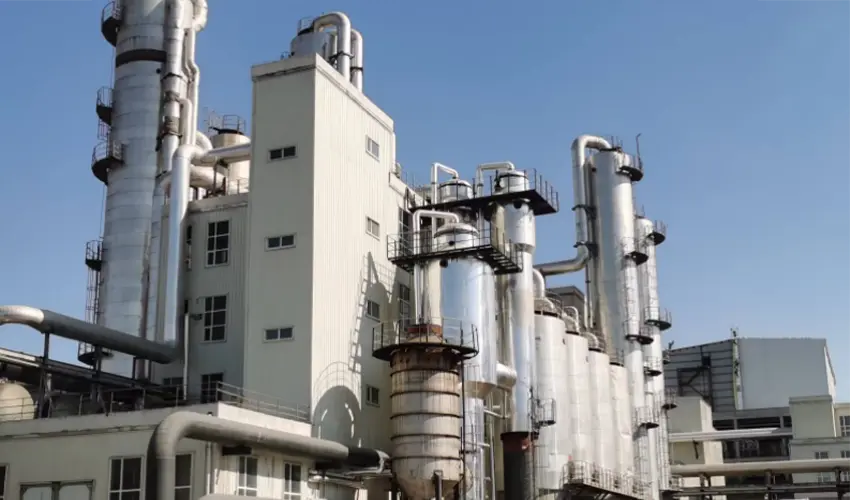
My observation across multiple integrated alcohol projects is that the companies that succeed in electronic-grade supply treat the production site as a single clean process cell. They do not segment “chemical manufacturing” from “cleanroom handling.” That unified perspective brings the grain receiving, steeping, fermentation, distillation, dehydration, and packaging units under a common contamination budget. At AGRIFAM, our engineering teams model the impurity mass balance from feedstock to final drum, using that model to set alert limits on incoming corn quality, process water conductivity, and CIP solution freshness. The discipline is heavy, but the result is a product that meets the fab’s certifier of analysis on every shipment, not just on the first.
If your project involves tight metal specifications or you are considering a custom packaging line within an existing alcohol complex, the configuration of the product path from molecular sieve outlet to fill head often becomes the deciding factor. Each additional transfer point is a risk. We routinely simulate the entire material flow before breaking ground, identifying where buffer tanks can be eliminated and where inline instrumentation can substitute for grab-sample QC. That upfront systems engineering is what prevents costly retrofits after commissioning.
With a dual-stage molecular sieve train, electropolished product piping, and ultrapure water for regeneration, our plants routinely deliver sodium below 5 ppb and total transition metals below 0.5 ppb. The practical floor is not the process but the analytical detection limit. We cross-check with inductively coupled plasma mass spectrometry to validate sub-ppb results, and we advise clients to budget for that level of QC instrumentation as part of the plant.
A retrofit is feasible if the distillation column has the hydraulic headroom for a higher reflux ratio and if the existing product path can be isolated from non-stainless components. The biggest hurdles are usually the storage and loading infrastructure. Fuel plants use large carbon steel tanks that cannot be passivated to semiconductor-grade standards; those vessels either need replacement or a dedicated, downstream clean product loop. We have completed projects where a new molecular sieve polish unit and clean product building were added to an existing fuel plant, but the upfront survey of every flange and gasket is essential. If your program involves an existing asset, it is worth confirming the metallurgy of all product-contact surfaces before committing to a timeline.
HPLC-grade ethanol targets UV-transparency and non-volatile residue, but its metal specifications are looser, typically <1 ppm, which is 1000 times higher than electronic-grade. Semiconductor-grade isopropyl alcohol often competes on residue, but ethanol has a broader solubility range for some photoresist strippers and offers a faster evaporation profile. Which solvent to choose comes down to the specific clean step and the fab’s qualified process. Our role is not to push one over the other, but to ensure that if ethanol is specified, the plant is engineered to deliver it with batch-to-batch metal consistency.
From feasibility study to mechanical completion, a greenfield electronic-grade anhydrous ethanol plant with 30,000 to 100,000 metric ton annual capacity usually takes 18 to 24 months. Permitting, especially for hazardous area classification and environmental impact assessment, can add six months in certain jurisdictions. The long-lead items are the molecular sieve vessels and the structured packing columns. We recommend ordering those as soon as the process design is finalized. Share your required capacity and location, and we can return a realistic schedule with local construction and commissioning considerations. For a confidential project review, reach out to bjhn@agrifamgroup.com or call 010-8591 2286.
If you’re interested, check out these related articles:
Driving Global Food Conservation Through Technological Innovation







bjhn@agrifamgroup.com